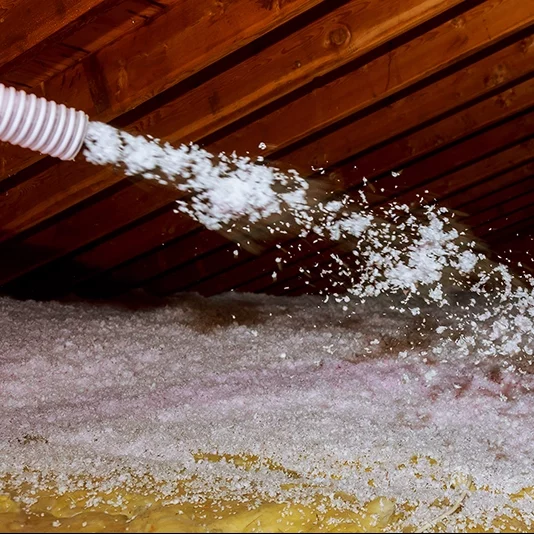
Southeast Texas sees a wide range of weather extremes, from freezing hail in April to record-breaking heat in August. That’s why homes in Magnolia, TX need protective attic insulation. Blown-in insulation provides the most effective heat protection and moisture control at an affordable price.
Blown-In Attic Insulation for High Performance & Quiet Comfort
Magnolia’s demographics show almost 70% of our housing is single-family homes valued between $285,000-$380,000. Most of those homes are designed with pitched roofs and an attic space for HVAC (heating, ventilation, and air conditioning) and storage. Homebuilders insulate attics to protect the roof, lower cooling and heating bills, and better manage extreme-heat movement that can make your HVAC work overtime delivering cool, comfortable indoor air.
Blown-in insulation provides:
- Moisture control – When cool air meets hot air, condensation can occur, leading to mold and mildew.
- Roof protection – Extreme temperatures can crack shingles or warp roofing materials.
- Thermal barrier – Insulation reduces the flow of heat, which saves energy.
- Year-round comfort – Indoor air is cool in summer, warm in winter.
Blown-in insulation can make rooms quieter. It reduces airborne noise by absorbing sound waves from music, overhead airplanes, loud talking, TV noise, and vehicular traffic. Noises are alleviated by insulation behind walls and above ceilings because blown-in fiberglass captures sound energy and converts it to heat particles. Blown-in insulation also reduces the number of hollow, empty spaces which cause sounds to echo.
Did you know approximately 90% of our homes are under-insulated? If your attic insulation is clean and dry, you can add blown-in insulation directly over older fiberglass batts or loose-fill.
In some cases, less is more when supplementing new, blown-in insulation over older installations. Too much attic insulation can actually cause roof damage due to trapped moisture and blocked airflow. It can also lead to dangerous overheating in recessed light fittings.
6 Types of Attic Insulation
Blown-in insulation is a popular choice for Magnolia, TX attics. In addition to seamless distribution – filling odd-shaped spaces and hard-to-reach crevices in your attic – the installation time is fast. It’s also more non-invasive (no hauling bulky rolls of insulation through the living room).
Choices for attic insulation in Northwest Houston include:
- Blown-in fiberglass/cellulose – Cellulose has better air-sealing properties than fiberglass, but it’s heavier and dustier. Fiberglass has greater moisture resistance and is lightweight, making it the preferred material for blown-in insulation.
- Fiberglass batts/rolls – This insulation offers pre-cut blanket-like sections that are placed between attic floor joists. It’s the cheapest option but fails to insulate small framing gaps.
- Mineral wool – Mineral wool, made from volcanic rock or industrial steel slag, can be shaped into batts and rolls. It comes in stiff, pre-cut rectangles that fit between floor joists, offering the most fire resistance.
- Radiant barrier – These foil-covered reflective sheets are installed directly under the roof decking. It is popular in Texas because it reflects radiant solar heat away from the attic, but is not a standalone solution; additional insulation is needed.
- Rigid foam board – This solid panel of plastic insulation is made from plastics (expanded polystyrene, extruded polystyrene, polyisocyanurate) and is usually applied to the underside of roof rafters. It insulates better than batts, is water-resistant, and a deterrent to bugs and rodents because it doesn’t provide nesting properties.
- Spray foam – Spray foam insulation provides a tight seal but is not considered eco-friendly (uses chemical compounds and petroleum products). It is costlier than blown-in fiberglass and doesn’t have blown-in attic insulation’s desirable airflow and ventilation properties.
Country Air: The Experienced Attic Insulation Company
In tough economic times, homeowners who can DIY (do-it-yourself) often save money. But attic insulation is never a DIY project. Handling old or contaminated insulation is a health hazard. Plus, too much insulation is just as problematic as not enough insulation. Country Air professionally installed attic insulation can extend the life of your home, improve air circulation, and maximize energy savings.
Our attic insulation experts will:
- Calculate the correct thickness.
- Safely navigate joists and carefully manage contaminated or hazardous materials.
- Seal hidden gaps, holes, and plumbing stacks.
- Use baffles to keep soffit vents open.
We recommend Owens Corning® blown-in insulation for your home. Its low-dust formula outperforms other types of insulation at a more affordable price. Call Country Air for a free estimate: 281-938-4826.
FAQs
Q: Does blown-in insulation “settle” over the years?
A: Blown-in insulation will settle over time due to natural compaction. Cellulose is heavier, so fiberglass insulation retains its insulative properties longer, with minimal settling.
Q: When do I need to add-to my attic insulation?
A: Attic insulation settles and likely needs additional blown-in insulation every 10-15 years.