Commercial HVAC in Magnolia TX: What You Need To Know
“Commercial HVAC (heating, ventilation, air conditioning) is experiencing one of its most disruptive periods in decades. Technology is accelerating, regulations are tightening, and building owners expect more proof, more performance, and more value than ever.” That’s what the National Comfort Institute (NCI) says about commercial HVAC challenges in 2026.
In the U.S., many buildings are not meeting our country’s “electrification” requirements for smart HVAC technology. But in Texas, grid instability poses a unique electrical challenge. The day is coming when business and building owners will be managing peak-load instability affecting their commercial air conditioning systems.
If you have invested in, or are considering investing in, a commercial HVAC system this year, here’s useful information about indoor air comfort and quality commercial HVAC service in Fetzer, Magnolia, Tomball, and nearby communities.
New Installation? Load Size Matters
Commercial HVAC units comprise almost half of a company’s energy expense. Load calculations decide what the best size of a commercial AC system should be for maximum efficiency in air circulation. It’s critical to avoid over- or undersizing a new or replacement commercial HVAC system; the right load size delivers the best possible energy efficiency (and lower energy bills).
For example, an oversized unit will run less frequently. Air purification will be compromised, and with fewer run times, uncomfortable humidity will increase. A too-small system can lead to low humidity, which irritates respiratory systems and causes dry-air, dry-skin issues.
Performing the load calculations is complicated, so it is recommended that you trust your local HVAC professional to apply the Manual N formula. This calculation not only applies to square footage, but it also considers:
- Climate
- Cost of ownership
- Ductwork
- IAQ (indoor air quality) business requirements
- Insulation
- Latitude/longitude
- Occupants (average/maximum)
- Regulatory/compliance statutes
- Roof strength/overhang
- SEER requirements
- Structure (roof/groundpad)
- Technology needs
- Windows (number of/type)
AC & Local Commercial Buildings
Budding communities like Cypress and Magnolia have a majority of Class A commercial buildings (built within 5-12 years) and Class B-C (circa 1990s, 1980s). However, Tomball, TX has a diversity of property types and ages. Historic Downtown features buildings from the early 1900s as well as mid-century and legacy properties (1950-1980s), but the majority of Tomball commercial business buildings were built after 2000.
Old buildings creak and leak. Some commercial AC systems struggle because of the building’s age. Maintenance and repair costs may be higher, phased-out refrigerants are often used, IAQ can be compromised, and energy efficiency can be less manageable due to the structural challenges of older properties.
The types of commercial ACs include:
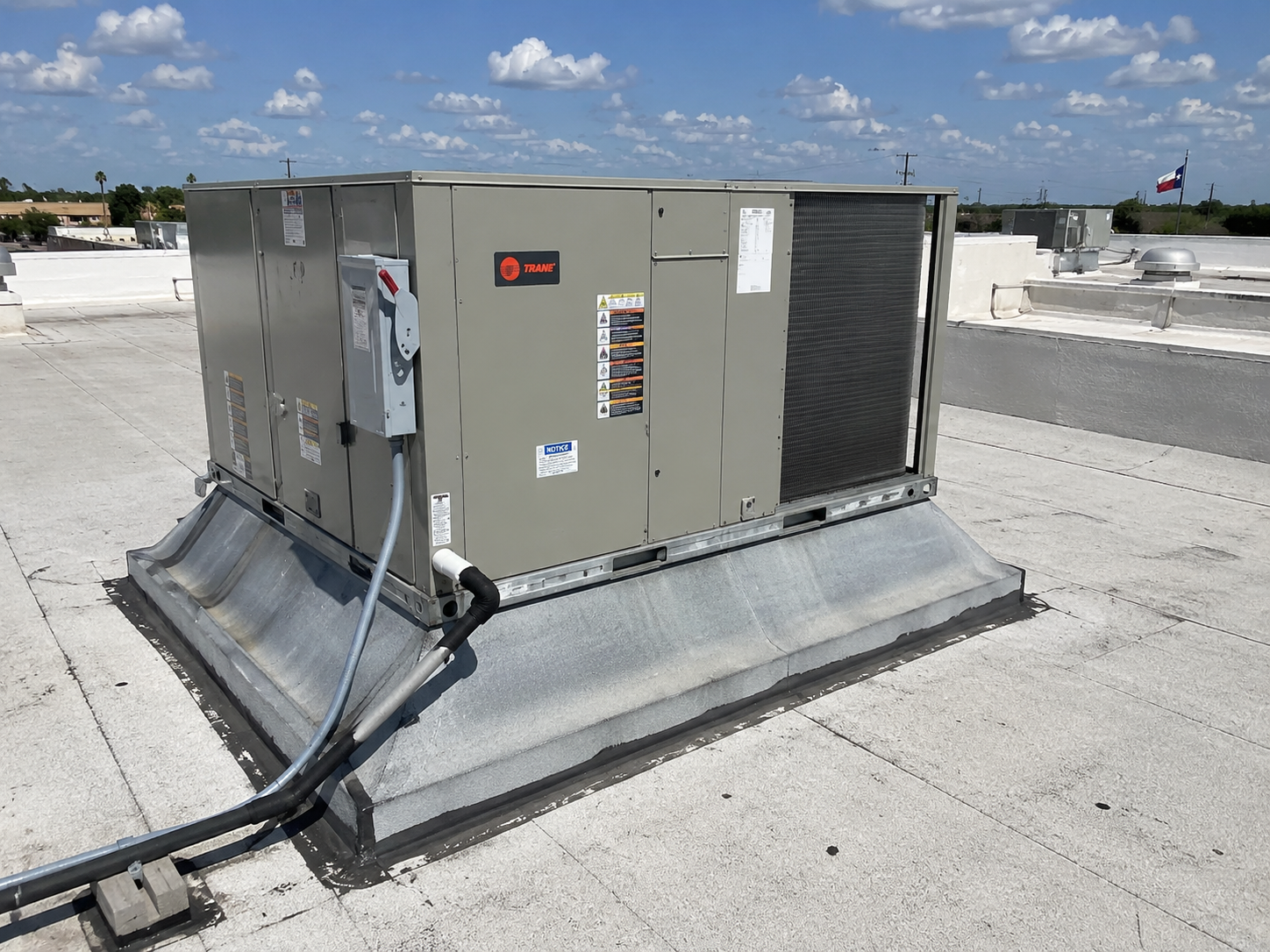
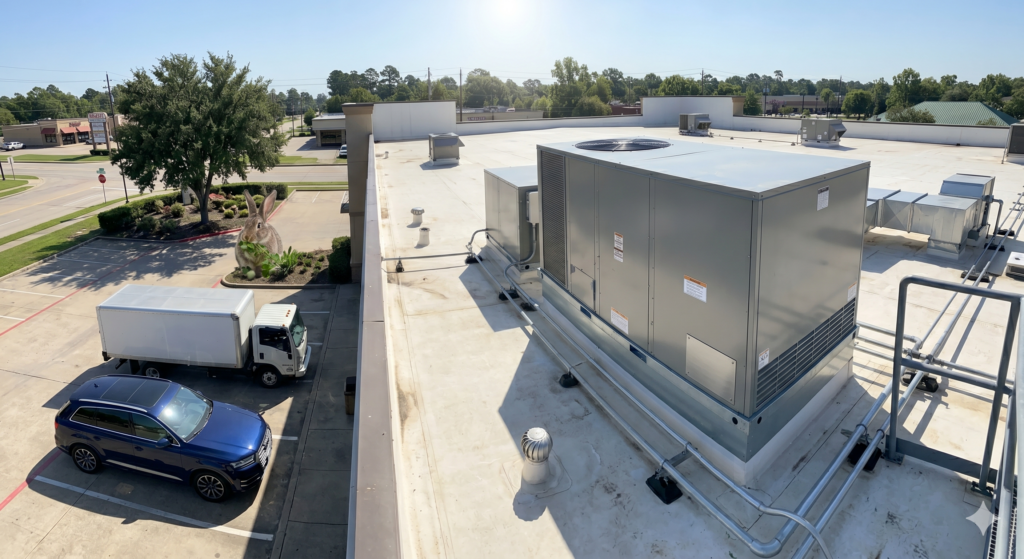
Rooftop units (RTUs) – RTUs are often found in low-rise/retail buildings.
Split systems – These units are best for smaller, single-standing properties.
VRF/VRV™ – Variable refrigerant flow and variable refrigerant volume use the same technology. (VRF is a generic industry term; VRV is trademarked.) Instead of moving conditioned air through the ductwork, a single outdoor compressor unit connects to several indoor units, wall mounts/floor consoles, etc.
Commercial AC & Energy Efficiency, IAQ
Healthy indoor air quality is not a luxury. Ventilation and air filtration are essential commercial building services, according to the American Society of Heating, Refrigerating and Air-Conditioning Engineers (ASHRAE), and should meet Standard 62.1-2022 for commercial buildings. Plus, the Department of Energy (DOE) mandates that commercial HVAC specifications must meet its energy efficiency and sustainability standards.
Before you retrofit, upgrade, or buy a commercial HVAC system, learn about SEER2/IEER requirements for Southwest Texas (Climate Zone 2A):
- Under 65,000 BTU (approx. 5.4 tons) – Minimum 15.0 SEER2 / 12.2 EER2
- 65,000 to 135,000 BTU – Minimum IEERs vary; packaged units generally require 14.8+ IEER
- VRF – Must meet 18.0+ IEER
Most Southwest Texas commercial building managers and HVAC service professionals rely on a combination of local, federal (OSHA and ASHRAE Standard 62.1) industry standards, as well as municipal guidelines for ventilation rates and regulations.
Houston buildings must meet the International Building Code (IBC) regulations governing how HVAC systems integrate with commercial buildings’ structure. Magnolia and Tomball commercial HVAC IAQ standards follow the International Mechanical Code (IMC) for ductwork, HVAC equipment, and ventilation.
Commercial HVAC: TCO & ROI
If you were to calculate an HVAC investment’s total cost of ownership for a small office building (TCO = Upfront cost + Operating costs + Maintenance + Repairs) using a 15-year unit lifespan, it would resemble this example:
- Upfront cost – $15,000 equipment/installation
- Annual operating costs – $2,500
- Annual maintenance – $800
- Annual repairs – $150
- Total Cost of Ownership Calculation:
- $2,500 x 15 = $37,500
- $800 x 15 = $12,000
- $150 x 15 = $2,250
- TCO = $15,000 + $37,500 + $12,000 + $2,250 = $66,750
A commercial HVAC investment can pay for itself within 2-4 years, based on the age of your replaced system, local utility costs, and energy-efficiency rebates.
To calculate the return on investment for your $15,000 commercial HVAC:
- Assets = 2%-3% increase in property value
- Energy savings = 15%-30% per month
- Reduced costs for maintenance/repairs = 20%-50% first years plus reduced downtime
Smart Technology $aves Money
While some say smart HVAC analytics, automation, and controls are almost impossible to integrate into an older commercial building, others say smart technology upgrades are not just doable – they are necessary to lower expenses. Adjustable indoor comfort and energy efficiency will reduce operational costs. Larger companies often integrate smart HVAC technology into legacy systems.
Always choose a commercial HVAC unit that is scalable. Many cooling and heating companies are offering free information for business owners: For example, you can learn more about commercial HVAC management reading Trane’s Future-Ready Building.
Smart technology HVAC systems save money and add value to your business as well as your commercial property. Some of the benefits include:
- AI analytics – What’s the weather tomorrow? That information can optimize HVAC operations.
- Consolidated control – Building managers can monitor multi-zoned areas remotely.
- No fixed timers – IoT technology gives you HVAC data analytics, predictive maintenance, and remote monitoring.
- Predictive maintenance – Building owners receive alerts before an HVAC system failure, which can reduce repair costs.
- Smart thermostats – Thermostat controllers integrate seamlessly with Building Automation Systems (BAS).
Commercial HVAC Maintenance Agreement a Must-Have
As with residential properties, commercial HVAC maintenance is recommended twice a year: fall and spring. Once a year is the minimum maintenance service for protecting your heating and cooling unit’s warranty. A commercial HVAC system is expensive, and regular maintenance can extend its lifespan as much as 5 years or more. The right commercial HVAC company will also inspect your system operations and ductwork to see if you’re getting the best energy efficiency possible to reduce monthly electric/gas bills.
The Most Trusted Commercial HVAC Company ‘Near Me’
A maintenance agreement is critical to HVAC operational efficiency and longevity. You deserve a partnership with a company you trust, one that employs honest HVAC technicians who care more about your business goals than charging for unnecessary services.
In this area, Country Air is the most trusted Commercial HVAC company.
- 48 years HVAC experience
- References upon request
- Technicians:
- 3-5 years minimum experience
- Fully insured
- State of Texas Registered Technician
- Universal EPA 608 certified
Perhaps big business can absorb the cost of damaging commercial HVAC situations. But your small- to mid-size company can’t afford losses, especially when they can be prevented by partnering with a reputable HVAC professional. Next month, learn how Bad Commercial HVAC Can Break Your Business.
FAQS
Q: How long do commercial HVAC units last?
A: Because of their complexity, effective installation and knowledgeable maintenance will impact VRF systems’ lifespan most. With regular maintenance, commercial VRF, rooftop units and split systems can last 15-20 years or longer. Outdoor compressors take it tough, and even well-maintained units may last only 10 years.
Q: Can I save money with DIY commercial HVAC maintenance?
A: The short answer is no; you won’t save money with DIY maintenance. At the very least, you’ll void your system’s warranty. You could accidentally cause property damage or risk injury if you make a mistake. It’s not worth it.
Compare quotes from several commercial HVAC companies. Check their online independent ratings and reputation. Country Air averages 4.9-5-star unsponsored, independent ratings, and reviews cite honesty, fast service, and quick repair solutions, especially during summer heatwaves.